Most comparison guides for these three systems read like a spec sheet with a bow on it. They give you a table, they say “it depends on your priorities,” and they leave you exactly as confused as you started.
We’ve pulled a lot of old systems out of Island homes and installed a lot of new ones. Here’s what we’ve actually seen — which system is the right answer for which home, where each one’s marketing claims fall apart, and when we’ve been wrong ourselves.
The three systems, plain-English
Gas furnace. Burns natural gas or propane to heat air, blows the hot air through ductwork. Same technology as your grandparents’ furnace with better efficiency and cleaner combustion. In BC, most residential natural gas is now Renewable Natural Gas by regulation — the environmental footprint is smaller than it used to be, but you’re still burning something.
Electric baseboard. Runs electric current through a resistance element until it glows warm. The heat rises off the fin, warms the room, dissipates. It is, mechanically, the simplest heating system possible. It also converts one unit of electricity into exactly one unit of heat — no more, no less.
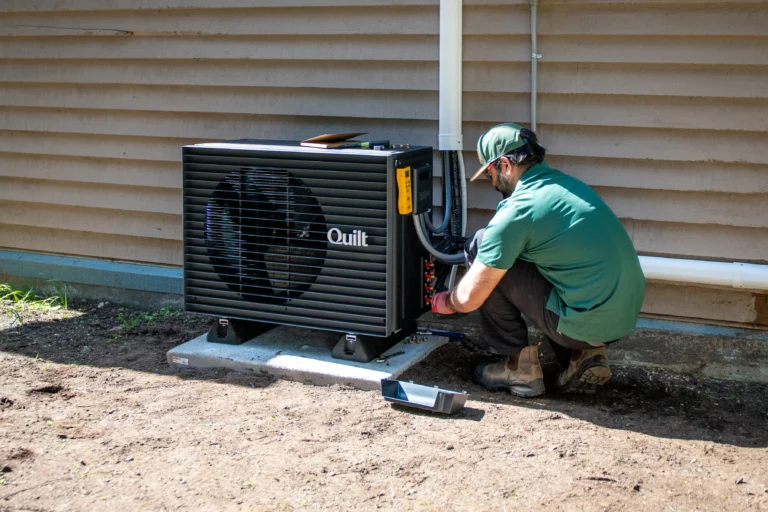
Heat pump. Doesn’t create heat, moves it. Pulls energy out of the outside air (yes, even cold air, down well below zero) using a refrigerant cycle, concentrates it, releases it inside. Because it’s moving existing heat rather than creating new heat, it delivers two to three units of heat for every unit of electricity it draws. That efficiency is why the rebate programs exist.
Reverse it in summer and it becomes an air conditioner. One system, two seasons.
Where each one is actually the right answer
Not “which is objectively best.” Different homes need different answers.
Heat pump is the right answer when:
- Your current system is oil, propane, or aging electric baseboard.
- You want cooling as well as heating (essentially every Island home built after 2015 has a customer asking about this).
- You qualify for the CleanBC ESP rebate, especially at the L1 tier (which we’ll get to).
- You’re planning to stay in the home more than five years.
- Your BC Hydro rate structure and your climate zone (South and Mid Island) reward efficiency — which they do.
Gas furnace is still the right answer when:
- You have existing gas service, existing functional ductwork, and you’re doing a like-for-like replacement while cash is tight.
- Your home is a rental where the operating cost sits with the tenant and the capital cost sits with you.
- You’re in a shoulder-of-the-envelope home — poor insulation, single-pane windows, drafty — where a heat pump has to work extra hard for peak-cold nights. That said, we still often recommend a hybrid (heat pump + gas furnace) rather than pure gas in this case.
- You’re building or replacing in the next 12–18 months and expect to move within three years — the payback math on a heat pump depends on you being in the home long enough to earn back the higher upfront.
Electric baseboard is the right answer when:
- It’s a secondary heat source for a room a heat pump can’t easily reach — an isolated basement suite, a garage workshop, a small addition where running a mini-split head is more work than the room’s use justifies.
- You’re in a tiny space (under 400 sq ft) that a heat pump would be oversized for.
- The house is a seasonal or rarely-heated space where the simplicity and zero-maintenance nature of baseboards outweighs their inefficiency.
That’s about it. For a primary heating system in a full-time home, baseboard hasn’t been the right answer in years.
The comparisons that actually matter
Skipping the spec-sheet table. Here’s what matters when you’re actually deciding.
Operating cost. Heat pump is meaningfully cheaper to run than baseboard — often less than half. Compared to a modern high-efficiency gas furnace, the operating cost is closer, but heat pump still edges out on the Island because BC Hydro electricity is one of the cheapest and cleanest in North America. We don’t quote a monthly number in copy because it depends on your insulation, your house size, and how you use it — but for the households we’ve converted from baseboard to heat pump, the winter Hydro bill drops noticeably.
Comfort. Heat pump wins here almost every time. Even, quiet, continuous warmth. Gas furnace cycles on and off — you feel the blast of heat and then the room drifts. Baseboard heats unevenly, from the floor up along one wall. The comfort difference is the thing customers mention most after an install.
Environmental footprint. BC’s grid is roughly 97% clean — hydro, wind, some biomass. A heat pump running on BC Hydro is one of the lowest-carbon heating systems you can install anywhere in North America. Gas is cleaner than it used to be but still involves combustion. Baseboard is BC-Hydro-clean but wildly inefficient, so it consumes 2–3x the energy of a heat pump for the same heat delivered.
Reliability. All three systems are reliable when installed properly. The failure modes differ. Gas furnaces have a heat exchanger and igniter that eventually go. Baseboards essentially never fail — the trade-off for being wildly inefficient is being mechanically simple. Heat pumps have compressors, refrigerant lines, and outdoor units exposed to weather — coastal salt is real. Annual maintenance is the equalizer for heat pumps; without it, the corrosion-and-refrigerant-loss cycle catches up.
The other reliability difference no one talks about is who has to coordinate the fix. A gas furnace issue can involve HVAC, a gas fitter, and an electrician if the ignition control is fried — that’s still often two vans on our end (a gas-ticketed HVAC tech and an electrician), but under one roof means one company scheduling them, one invoice, one point of accountability. No hunting for a subcontractor. No finger-pointing between companies about whose problem it is.
Cooling. Only the heat pump gives you AC. This is not a small thing anymore on the Island. The 2021 BC heat dome killed hundreds of people. We’ve seen retroactive cooling requests climb noticeably since.
Where we’ve been wrong
Two conversions we look back on and think we should have talked the customer into something else:
- An oversized ductless system in a small Sooke home. The customer insisted on a four-head unit — we’d recommended a properly-sized smaller system and pushed back, but they were firm. A year in, they still weren’t happy with how the system was running. We invoked our 100% Satisfaction Guarantee, pulled the four-head, and put in the smaller system we’d originally quoted. Customer happy. Lesson learned: push back harder on oversizing, even when the customer insists it’s what they want.
- A hybrid gas-plus-heat-pump for a Metchosin homeowner who barely used the gas backup. They insisted on the dual-fuel setup even after we’d flagged it as overkill for their usage pattern. In hindsight the added cost and complexity wasn’t worth it — a properly-sized cold-climate heat pump alone would have covered them, and the second-guessing on brand choice made the aftercare harder than it needed to be.
Nobody in the industry admits this kind of thing publicly. We do because it’s how you tell whether a contractor is actually paying attention to what customers are experiencing.
What the rebate math changes
The July 6, 2026 CleanBC changes rewrote the payback math. Two things to know for a heat pump conversion:
- Electric-to-heat-pump is now ESP1-only. If your household income is above the ESP1 threshold and you’re currently on baseboard, the CleanBC rebate is off the table. The operating cost savings still often make the switch worthwhile, but you’re financing the conversion yourself.
- Oil, propane, or gas conversions are still eligible across all three tiers, sliding from up to $13,000 (L1) down to $3,500 (L3) for a central ducted system.
- BC Hydro adds up to $4,000 base plus $1,000 bonus for installs paid by October 31, 2026.
- Greener Homes Grant is closed to new applicants. OHPA is closed to new applicants. Greener Homes Loan (up to $40,000, 0% interest, ten-year) is still open if you need to finance.
Full current stacking and eligibility in our BC Rebates 2026 guide.
The honest recommendation
For most Island homeowners in 2026: a properly-sized cold-climate heat pump is the right answer for the next system you install. Not because it’s trendy, and not because we sell them. Because on the Island’s climate, with BC Hydro’s grid, at the current rebate levels, with cooling included, it just wins on the math.
The exceptions are real but narrower than they used to be. If you’re in one of the exception buckets — small secondary spaces, rental with cost sitting on the tenant, extremely tight timeline before a planned move, extreme envelope issues — a gas furnace or baseboard might still be right. In every other case, we’d tell you heat pump.
What to expect on an assessment
We come to your home, walk the space, measure your existing system, and give you a written comparison based on your actual home — not a spec sheet. If the heat pump is the right call, we tell you why. If it isn’t, we tell you why not. No obligation.
Family-owned. Island-grown. 4.9 ★ Google Rated across the Island.
Call (236) 361-8293 or book an assessment through our contact page.
— The Sasquatch Field Team